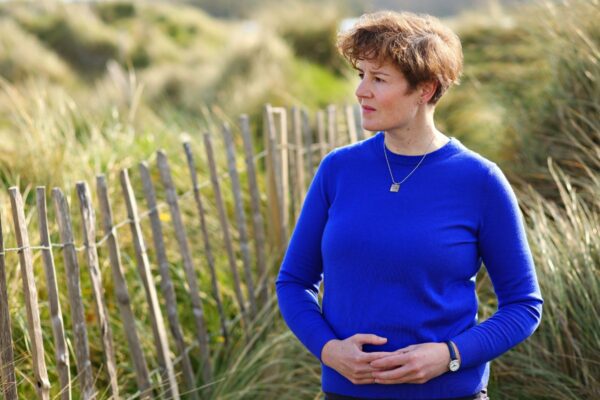
Writer, Elaine Garvey, reflects on what she learned and enjoyed during her journey from her home in Ireland, via bus, train, ferry and foot, to Edinburgh’s renowned annual book festival.
To create a game, or a story, or a viable reality, we need a framework — what is constant, what is variable — to shape the outcomes. This is how the world is because this is how we have made it.
In 2025, the Edinburgh International Book Festival, in partnership with Culture Ireland, invited me to take part in a sustainable travel initiative to reduce carbon emissions. That was the framework for my journey from the Atlantic coast of Ireland to the North-Sea coast of Scotland. I accepted the invitation and expected it to be arduous and tedious. Two days getting there, two days getting back, approximately 700km each way, without going through an airport. I could have flown from Shannon or Dublin. Instead, I travelled over land by trains and across the Irish Sea by ferry from Dublin to Holyhead. (Travelling via Belfast is a shorter route by car, but the public transport links from where I live make it far longer: there is no direct service from Sligo to Belfast.)
Sipping tea and fuelling up
There were multiple delays and cancellations. I spent the best part of a Wednesday afternoon in Preston train station, sipping tea and watching the departures board. I also had conversations about racing pigeons, failed valves in power stations and signal cabling theft while the accents, topography and islands changed around us. I loved it. The generosity of the time allowed, and the time I allowed myself to take, was a gift. The impact it has made on me, on my psyche and my understanding of our shared histories, continues to reverberate.
Events slowed me down more than expected, a cancelled ferry on day one and then train disruptions on day two, because of theft of live cabling for copper wire. I was standing on a stationary train outside North Wigan, in conversation with a group of passengers, when a woman suggested adjusting our expectations would help. It did. The trains from then on were declassified; there was no first or second class. The goal was to get us to our destinations safely, which is what happened.
The young fella who was working in Edinburgh Waverley Train Station when I arrived that night was also working on the day I started my return journey, and we recognised each other. I asked him what time he had finished his shift on the day of the delays? 2.15am, he said, instead of 11pm. He was remarkably chipper — ‘When you hear a delay announced,’ he told me, ‘first thing you do, go and get food.’
Getting to and from the ferry ports as a foot passenger was tricky. A cancelled fast ferry made it much easier for me to make the connection to Dublin Port, and then, I boarded a slow ferry. It
brought back all my happy memories of travelling by sea. The freedom to roam between decks,
spaces for people and pets to move, stretch, go outside, or rest in the quiet zone. Travel designed for
living beings, not cargo. No backache, no swollen ankles. I did not know before this trip that
Holyhead is on Holy Island, the Fort of Saint Cybi, and was invaded by the Irish after the Romans.
If I had flown, I’d never have stood in a field stargazing by Anglesea or heard the soundscape on
Welsh trains, which was, appropriately, very Welsh. Placenames spoken in the landscape, language
and accent that created them is enriching. I had an absolutely delightful conversation travelling back
through the Lake District on the way home with a retired midwife who visits her son and her
hairdresser in Edinburgh every seven weeks and watches the seasons turn as she travels. A man who
takes the ferry weekly between Ireland and Wales chatted to me as we disembarked in Dublin. He is
from both places, he said, whatever the term for that is.
Travel modes and times
Total hours
Hours
Mode of transport
Bus
1
Train
29
Ferry
7
Taxi
1
Savouring the journey
I am able bodied, I can negotiate steps and I am an English speaker. The logistics, the research and
the bookings were organised by the book festival, all I had to do was show up. This is important to
acknowledge, as well as the good weather, averaging 16 to 22 degrees Celsius, with a light breeze
and no rain.
We know climate change is happening. We know this blue planet is our only home. The arguments
for slow travel are somewhere between the binaries of: Who can afford to travel slowly? And: Who
enjoys living at a frantic pace? In Edinburgh, I spoke at a festival event and the topic of cultural
differences came up. An audience member asked me about Ireland and Britain, how we are
neighbours, but we’re not really neighbours. Because I had been documenting this trip, I was able to
link my practice of writing directly with the moment of sharing the work. I said I was planning to
play slow-travel bingo with the photos I’d taken — it was hard to tell which images were in which
country. We are first cousins by land and sea. A book festival brings us together and this is to be
celebrated.
Creating fiction, trying to embody characters and allowing them to become themselves,
exercises my focus and patience to their limits. Efficiency is something I’m trying to learn to resist
— it is so ingrained, I find it a difficult habit to shift. You miss out on too many possibilities when
you rush to the end; you don’t get to experience the landscape, to build connections, to savour the
atmosphere of a place. The stories start to come out when we slow down.
After I returned home, I dreamed about cows through train windows and didn’t know where I was
when I woke up. I had been on a journey. An eventful, memorable journey.
Play slow-travel bingo
Where was Elaine on her journey?
Ireland? Scotland? Wales? England? Answers at the end of the article.
1.
2.
3.
4.
5.
6.
Image credits: Elaine Garvey
About the author
Elaine Garvey is from County Sligo, Ireland. The Wardrobe Department (Canongate) is her first novel and was selected by The Sunday Independent, The Irish Times, The Financial Times and the BBC in their choices of the best new debut fiction in 2025. Elaine’s short stories have been published in The Dublin Review and Winter Papers.
Image credit: Mark Capilitan
About the initiative
Edinburgh International Book Festival‘s Sustainable Travel Initiative was supported by Culture Ireland and enabled three authors to travel to Edinburgh for the 2025 festival by ferry and train rather than by air.
Slow-travel bingo answers: 1. Treaddur Bay, Wales. 2. Sligo Bay, Ireland. 3. Connolly Station, Dublin, Ireland. 4. New Town, Edinburgh, Scotland. 5. Public Library, Holyhead, Wales. 6. Preston Train Station, England.
NB: We’ve adapted the game a little; Elaine’s original version had 12 images.
Manage cookies
To provide the best experience, we use technologies like cookies to store and/or access device information.
Functional
Always active
The technical storage or access is strictly necessary for the legitimate purpose of enabling the use of a specific service explicitly requested by the subscriber or user, or for the sole purpose of carrying out the transmission of a communication over an electronic communications network.
Preferences
The technical storage or access is necessary for the legitimate purpose of storing preferences that are not requested by the subscriber or user.
Statistics
The technical storage or access that is used exclusively for statistical purposes.The technical storage or access that is used exclusively for anonymous statistical purposes. Without a subpoena, voluntary compliance on the part of your Internet Service Provider, or additional records from a third party, information stored or retrieved for this purpose alone cannot usually be used to identify you.
Marketing
The technical storage or access is required to create user profiles to send advertising, or to track the user on a website or across several websites for similar marketing purposes.